Glossary
Drainage & sewer terms, in plain English.
40 definitions so the quote, the camera report and the contractor all make sense.
- 40 terms
- Searchable
- Backwater valve
- A one-way valve in the sewer line that closes if sewage tries to flow backward into the house.
- Belly
- A low spot in a sewer pipe where water and solids collect, usually caused by soil settling.
- Catch basin
- A grated box set in the ground that collects surface water and sends it into a drain pipe.
- Channel drain
- A long, narrow drain with a grate that catches water across a width, such as a driveway or patio.
- CIPP
- Cured-in-place pipe: a resin-saturated liner cured inside an existing pipe to form a new pipe within the old one.
- Cleanout
- A capped access pipe on a sewer or drain line used for cleaning and inspection.
- Culvert
- A pipe or box that carries water under a road, driveway or embankment.
- Curb inlet
- A street-side opening in the curb that lets storm water into the public storm sewer.
- Dry well
- An underground pit that stores storm water and lets it soak into the soil.
- Efflorescence
- White mineral deposits left on concrete or block when water carries salts to the surface and evaporates.
- Emitter
- A cap at the end of a buried drain pipe that opens under flow and releases water onto the surface.
- Erosion blanket
- A biodegradable mat used to hold soil and seed on slopes until plants take root.
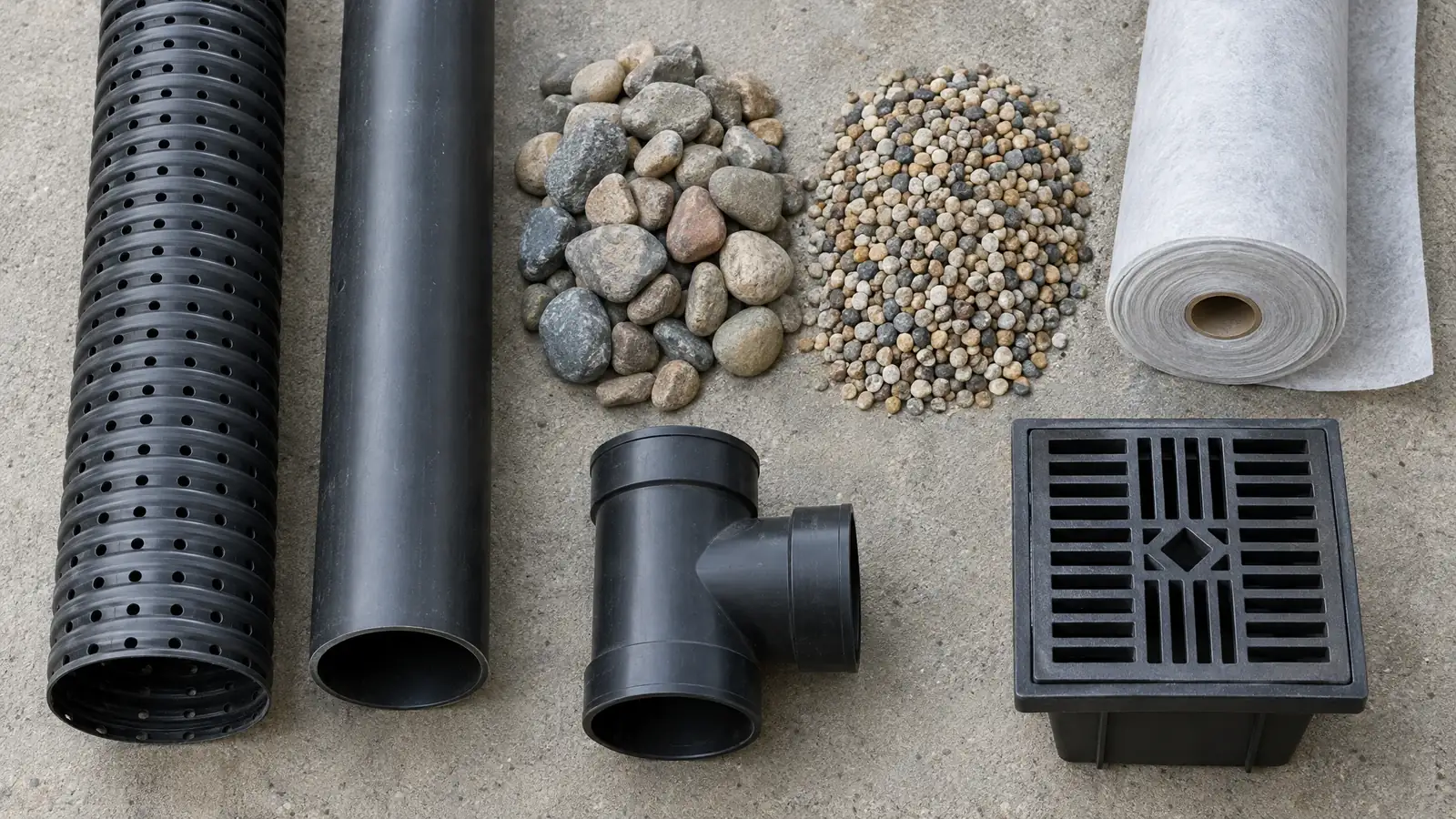
- Filter fabric
- A permeable fabric that keeps soil out of gravel while letting water through.
- Footing drain
- A perforated pipe at the base of a foundation that collects groundwater and carries it away.
- French drain
- A sloped trench with perforated pipe in gravel that collects and carries water away.
- Grade
- The slope or elevation of the ground, or of a pipe.
- Grease interceptor
- A large in-ground tank that separates grease from kitchen wastewater before it enters the sewer.
- Hydro jetting
- Cleaning pipes with high-pressure water from a special nozzle.
- Infiltration
- Groundwater entering a sewer through cracks and open joints.
- Inversion
- The process of turning a liner inside out as it is pushed into a pipe, so the resin side presses against the pipe wall.
- Lateral
- The private sewer pipe from your house to the main sewer.
- Main line
- The larger sewer pipe that collects flow from laterals.
- Orangeburg
- A mid-20th-century fiber-and-tar sewer pipe that can soften and deform with age.
- Perforated pipe
- Drain pipe with small holes or slots that let water enter along its length.
- Pipe bursting
- A trenchless method that breaks an old pipe while pulling a new pipe through the same path.
- Pop-up emitter
- A discharge fitting set flush in the lawn that pops open when water flows through it.
- Rational method
- A simple formula for peak storm flow: runoff coefficient times rainfall intensity times area.
- Retaining wall
- A wall that holds back soil on a slope.
- River rock
- Smooth, rounded stone used for drain beds, swales and decoration.
- Runoff coefficient
- A number from 0 to 1 that shows how much rain becomes runoff on a surface.
- Scale
- Mineral and rust deposits that build up inside older pipes.
- Sewer scope
- A camera inspection of a sewer line.
- Sump pump
- A pump in a pit that removes groundwater from a basement or crawl space.
- Swale
- A shallow, broad channel that guides surface water across a yard.
- Trap
- The curved section of a drain that holds water to block sewer gas.
- Trenchless repair
- Pipe repair or replacement that avoids digging a continuous trench.
- Tuberculation
- Rough bumps of rust that form inside iron pipes.
- Vitrified clay pipe
- Hard-fired clay sewer pipe, common in older sewers, with many joints.
- Water table
- The level below which the ground is saturated with water.
- Weep hole
- A small opening in a retaining wall or foundation that lets water escape.
B
C
D
E
F
G
H
I
L
M
O
P
R
S
T
V
W
No terms match that search.
Ask a real person.
Describe what you are seeing and we will explain it.